
For business owners asking, “How much should a company spend on accounting?” TGG uses 1% to 3% of revenue as a practical planning benchmark for total accounting costs. The right level depends on the business’s complexity, transaction volume, reporting requirements, and the financial expertise needed.
ACCOUNTING WORK SHOULD BE DONE AT THE RIGHT LEVEL
Accounting roles can range from CFO and Controller to Accounting Manager, Staff Accountant, payroll, and accounts receivable positions. Each carries different responsibilities and costs, so the goal is to match the work with the appropriate level of expertise.
For business owners, however, determining whether accounting work is being handled accurately and at the appropriate level can be difficult. Accounting professionals may use terminology and processes that aren’t familiar to people outside the field, and problems may not become apparent immediately.
As Matt Garrett, founder and CEO of TGG Accounting, explains, “You’re getting bad financials, they’ve missed payroll, somebody’s not gotten paid correctly… what’s going on?”
Understanding what each accounting role should do, and what that level of expertise should cost, can help businesses build a more effective accounting department.
HOW SHOULD YOU BENCHMARK COSTS?
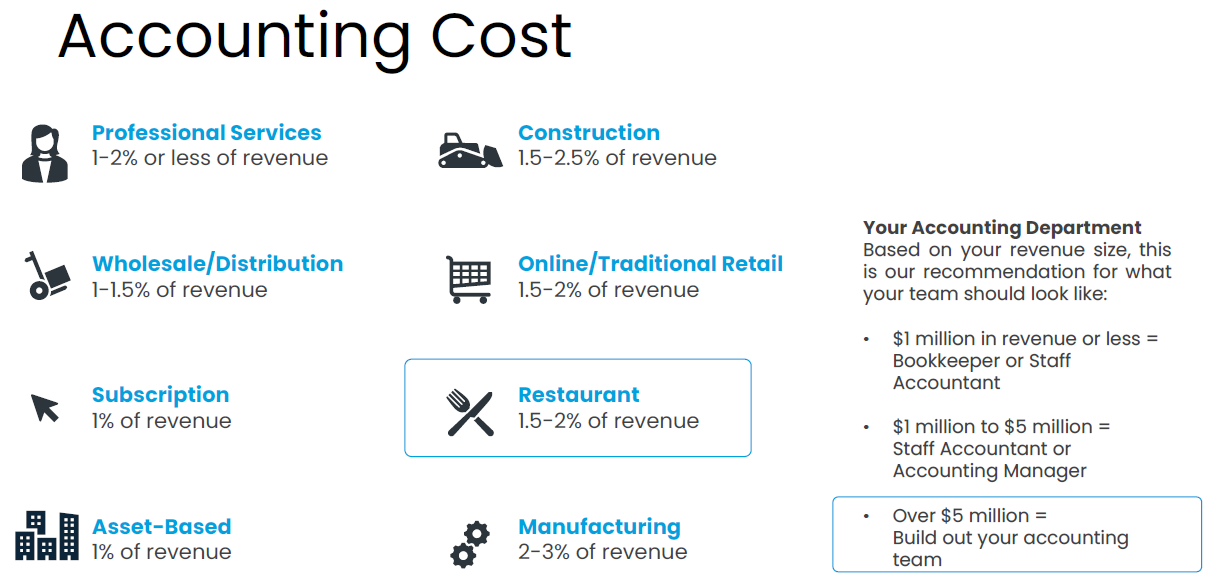
TGG uses accounting fees as a percentage of revenue as one way to evaluate whether the overall finance and accounting function is appropriately resourced.
WHAT SHOULD BE INCLUDED IN YOUR ACCOUNTING BUDGET?
When calculating total accounting costs, consider the full cost of supporting the function, including:
- All of your day-to-day accounting.
- Audit fees (if you have them).
- Any kind of tax consulting or tax CPA fees.
- Compensation and benefits for internal accounting staff, when applicable.
- Accounting, reporting, and related finance technology.
- Outsourced accounting, Controller or CFO support, when applicable.
Outside tax and assurance costs may be included when evaluating the company’s overall accounting budget, even though TGG does not provide tax return preparation, audits, or CPA-reviewed or compiled financial statements.
HOW CAN YOU TELL IF YOU’RE SPENDING TOO MUCH OR TOO LITTLE?
How much does the average company spend on accounting? Garrett says: “Unfortunately, what I find is that most of us business owners are either spending way too little—we’re a $10 million business with a $1500 a month bookkeeper, our books are a mess, we never get financials, and we don’t even look at them—or we’re a $10 million business and we’ve got a $400,000 CFO who’s reconciling the bank account. Neither of those is perfect.”
When answering the question, “How much should a company spend on accounting?”, the revenue percentage alone doesn’t tell you whether the accounting function is appropriately staffed. Books that are consistently behind, unreliable reporting, or senior employees spending time on basic accounting work can all point to a structure that needs attention. At the other end, duplicated responsibilities or full-time senior capacity the business doesn’t consistently need can increase cost without adding proportional value.
WHY DO ACCOUNTING COSTS VARY BETWEEN BUSINESSES?
So, how do you determine whether you should be spending closer to one percent or closer to three percent? That can be a big disparity.
If you’re a service business where it’s almost all payroll, invoicing, and things like that, you’re down in the 1% range.
If you’re a manufacturing business, you have a thousand different parts and raw materials that come in, and you have to put it all together and keep track of the inventory. Then, you have a bunch of fixed finished goods inventory—that’s very complex accounting. So, that would be more in the 3% range, Garrett says.
Transaction volume, inventory, number of entities, payroll complexity, reporting requirements, the condition of the existing books, and the need for Controller or CFO oversight can all move accounting costs higher or lower. Two companies with the same revenue may therefore need very different accounting budgets.
WHAT SHOULD YOU GET FOR WHAT YOU SPEND?
When assessing how much should a company spend on accounting, cost is only part of the equation. The right accounting budget should produce more than completed transactions. Leadership should have current books, timely financial statements, clear review and accountability, useful management reporting, and enough visibility into cash and profitability to make informed decisions.
HOW SHOULD YOU COMPARE IN-HOUSE VS OUTSOURCED ACCOUNTING COSTS?
Compare the full cost and capacity of each model rather than looking only at salary or monthly fees. An in-house team may involve salaries, payroll taxes, benefits, recruiting, technology and management time, while an outsourced engagement should be evaluated based on scope, expertise, team structure, and the responsibilities included.
The right structure may also combine both models. An outsourced accounting team can work alongside internal staff when a business needs additional expertise or oversight without replacing the entire accounting function.
“But remember,” Garrett warns, “use percentages, not dollars. That gives you a consistent way to evaluate accounting spend as the business changes. And make sure you get accurate and timely information.”
If you’re interested in finding out, “How much should I be spending on accounting?” feel free to reach out to us—we’ll be happy to give you an idea.
FAQS ABOUT HOW MUCH SHOULD A COMPANY SPEND ON ACCOUNTING
How much is bookkeeping per month?
Bookkeeping costs depend on the size and complexity of your business. Outsourced bookkeeping services typically range from $500 to $2,500 per month. In-house bookkeepers may earn salaries between $40,000 and $60,000 annually.
What is the difference between a bookkeeper and an accountant?
A bookkeeper manages day-to-day transactions and reconciliations. An accountant reviews that work, prepares financial statements, and helps interpret the results.
How much does it cost to clean up messy books?
Cleanup costs depend on how far behind the books are, transaction volume, and how complete the records are. Because it is usually one-time work, it should be budgeted separately from ongoing monthly accounting.
When should a business move from a Bookkeeper to a Controller or CFO?
A business may need higher-level support when reporting becomes more complex, financing or investors are involved, or leadership needs forecasting and analysis. Controllers focus on reporting and oversight, while CFOs focus more on planning and strategy.
Are accounting fees tax deductible for a business?
Business accounting fees are generally deductible when they are ordinary and necessary expenses. Because treatment can vary by service and business structure, confirm the specifics with your tax advisor.
Read More >>>

Matt Garrett is the Founder and Chief Executive Officer of TGG. He is a regular speaker across the country on behalf of Vistage educating business owners on the need for sound financial practices, and is Vice President of the Board of Directors of FINACA. Under Matt’s leadership, TGG has received the following recognition: INC. 5000 top companies in the U.S. five years in a row; one of “San Diego’s Fastest Growing Companies” the past four years; and is among San Diego’s “Best Places to Work.”