
Staff accountants handle the day-to-day financial work that keeps a company’s books accurate and current. By following established processes, documenting transactions, and maintaining reliable records, they create the financial foundation that managers, controllers, and CFOs use to evaluate the business.
What Does a Staff Accountant Do?
A staff accountant:
- Records financial transactions
- Reconciles accounts
- Prepares financial statements
- Supports audits
- Assists with budgeting
- Helps manage payroll
Staff accountants typically work under a senior accountant, accounting manager, or controller to keep a company’s financial records complete, accurate, and ready for review.
Daily Financial Tasks
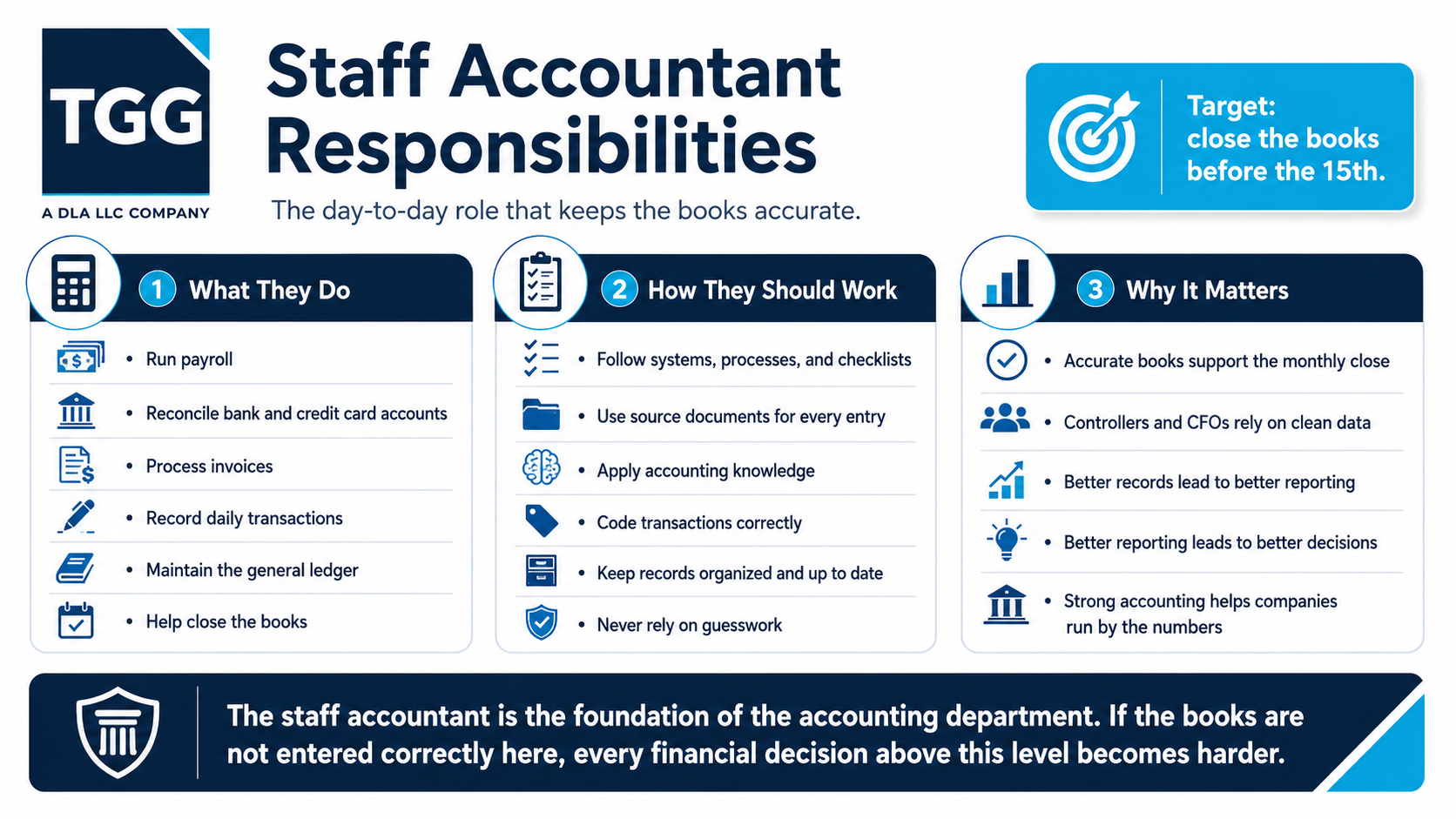
One of the primary staff accountant responsibilities is handling the day-to-day financial activity that keeps a business on track. This may include running payroll, reconciling bank and credit card accounts, processing invoices, recording income and expenses, and maintaining the general ledger.
Staff accountants should complete these duties through documented systems, processes, and checklists rather than relying on memory or guesswork. Every transaction entered into the accounting system should be supported by a source document, such as an invoice, receipt, bank record, contract, or payroll report, that clearly explains what occurred.
Closing the Books on Time
Staff accountants play an important role in the monthly close process. They should reconcile accounts, verify transaction coding, collect missing documentation, and complete routine entries so the company’s books can be closed accurately and on time. A well-run accounting department should generally aim to complete this work before the 15th of the following month.
Timely closing gives controllers, CFOs, and business owners access to current financial information. When the books remain incomplete or contain unsupported transactions, the rest of the accounting department cannot reliably analyze performance or advise leadership.
Financial Reporting
Staff accountants are also responsible for generating various financial reports. These reports give business owners, managers, and other stakeholders a clear picture of the company’s financial status. A key report that staff accountants prepare is the balance sheet, which summarizes the company’s assets, liabilities, and equity at a specific point in time. They also create income statements, which show the company’s revenue and expenses over a certain period, and cash flow statements that track the flow of cash in and out of the business. These reports help managers make informed decisions about operations and investments.
In some cases, these reports are also used to support larger strategic efforts, such as mergers, acquisitions, or outside evaluations, where due diligence consulting may rely on accurate, well-prepared financial data to assess risk and validate business performance.
By preparing these financial documents, staff accountants help ensure that the company complies with financial regulations and has a clear understanding of its financial position.
Supporting the Month-End Close
Staff accountants help complete the month-end close by reconciling accounts, reviewing transaction coding, recording necessary journal entries, and preparing supporting schedules. These schedules may cover accounts receivable, accounts payable, payroll accruals, loans, fixed assets, prepaid expenses, and other balance-sheet accounts.
Completing this work accurately and on schedule allows the accounting manager or controller to review the company’s financial statements and identify unusual balances, missing information, or potential errors before reports are delivered to leadership.
Supporting Audit Readiness
When a business undergoes an internal or external audit, staff accountants play a key role by providing auditors with the necessary documents, such as transaction records, financial statements, and other reports. This process ensures transparency and accuracy, helping companies meet legal and regulatory standards regardless of industry. Whether you are dealing with construction, fintech, or healthcare billing companies the documents and processes may be different and your staff accountant should master them all.
Staff accountants prepare for audits by ensuring that the company follows accounting standards and government regulations. If any financial inconsistencies arise, they help identify and resolve them before they become major issues. This proactive approach reduces the risk of penalties and helps maintain the company’s reputation.
Budgeting and Forecasting
Staff accountants also contribute to a company’s budgeting and forecasting processes by analyzing past financial data to help predict future trends. This information is crucial for setting budgets and allocating resources for the upcoming fiscal year. Additionally, it helps business leaders make informed decisions about future growth and profitability. By providing accurate financial forecasts, staff accountants enable companies to plan for the future and make strategic choices that can drive success.
Assisting in Payroll
Staff accountants may support payroll by reviewing payroll reports, recording payroll entries, reconciling payroll liabilities, and confirming that wages, benefits, and payroll taxes are properly reflected in the accounting records. Depending on the organization, the actual calculation and processing of payroll may be handled by an internal payroll specialist or outside provider.
FAQs About Staff Accountant Responsibilities
What qualifications does a staff accountant need?
A staff accountant should have a working knowledge of accounting principles and understand how to record transactions accurately. Many staff accountants hold a degree in accounting or a related field, but formal credentials are not the only path. Someone with bookkeeping experience may also succeed in the role if they are actively developing their accounting knowledge through coursework, training, or supervised experience. Attention to detail, consistency, and a commitment to accuracy are essential.
How does a staff accountant differ from a bookkeeper?
While both staff accountants and bookkeepers manage financial records, staff accountant job responsibilities are typically more advanced. Staff accountants often handle financial reporting, audits, and tax preparation, whereas bookkeepers focus on recording daily transactions and maintaining ledgers.
Can a staff accountant help with tax preparation?
A staff accountant can help organize tax records, reconcile accounts, prepare supporting schedules, and provide accurate financial information to a company’s tax professional. Some staff accountants with specialized tax experience may assist more directly, but formal tax filings and tax advice are generally handled by qualified tax professionals.
How does a staff accountant help in financial decision-making?
Staff accountants provide critical financial data that helps business leaders make informed decisions. By generating reports such as balance sheets, income statements, and cash flow statements, one of the important staff accountant duties and responsibilities is giving management a clear view of the company’s financial health. This information is essential for budgeting, forecasting, and strategic planning.
How do staff accountants support a company’s controller?
Staff accountants provide the accurate records and financial data controllers need to oversee company operations. A controller may also review vendor relationships and expenses, including providers such as PreSearch background services, to understand which outside companies the business uses and ensure their costs are properly documented.
Who does a staff accountant report to?
A staff accountant commonly reports to a senior accountant, accounting manager, assistant controller, or controller. In smaller companies, the staff accountant may report directly to the owner or CFO. The reporting structure depends on the size and complexity of the company’s finance department.
How can I know that I’ve hired the right staff accountant?
If you’re wondering how to know if you’ve hired the right staff accountant, assess whether they possess the following qualities: a keen eye for detail, a growth mindset, integrity, and organization, as well as excellent communication and time-management skills. A good accountant doesn’t just fulfill the necessary staff accountant responsibilities—they must also possess soft skills to work well with your team.
Why is accuracy so important for a staff accountant?
The staff accountant creates the financial records used by controllers, CFOs, and business owners. If transactions are entered incorrectly, entered without supporting documentation, or assigned to the wrong accounts, every report and decision that follows may be affected. Accurate day-to-day accounting allows the rest of the finance team to analyze the business and help leadership run it by the numbers.
Read More >>>

Matt Garrett is the Founder and Chief Executive Officer of TGG. He is a regular speaker across the country on behalf of Vistage educating business owners on the need for sound financial practices, and is Vice President of the Board of Directors of FINACA. Under Matt’s leadership, TGG has received the following recognition: INC. 5000 top companies in the U.S. five years in a row; one of “San Diego’s Fastest Growing Companies” the past four years; and is among San Diego’s “Best Places to Work.”